
Blockchains Were Created to Remove Counterparty Risk
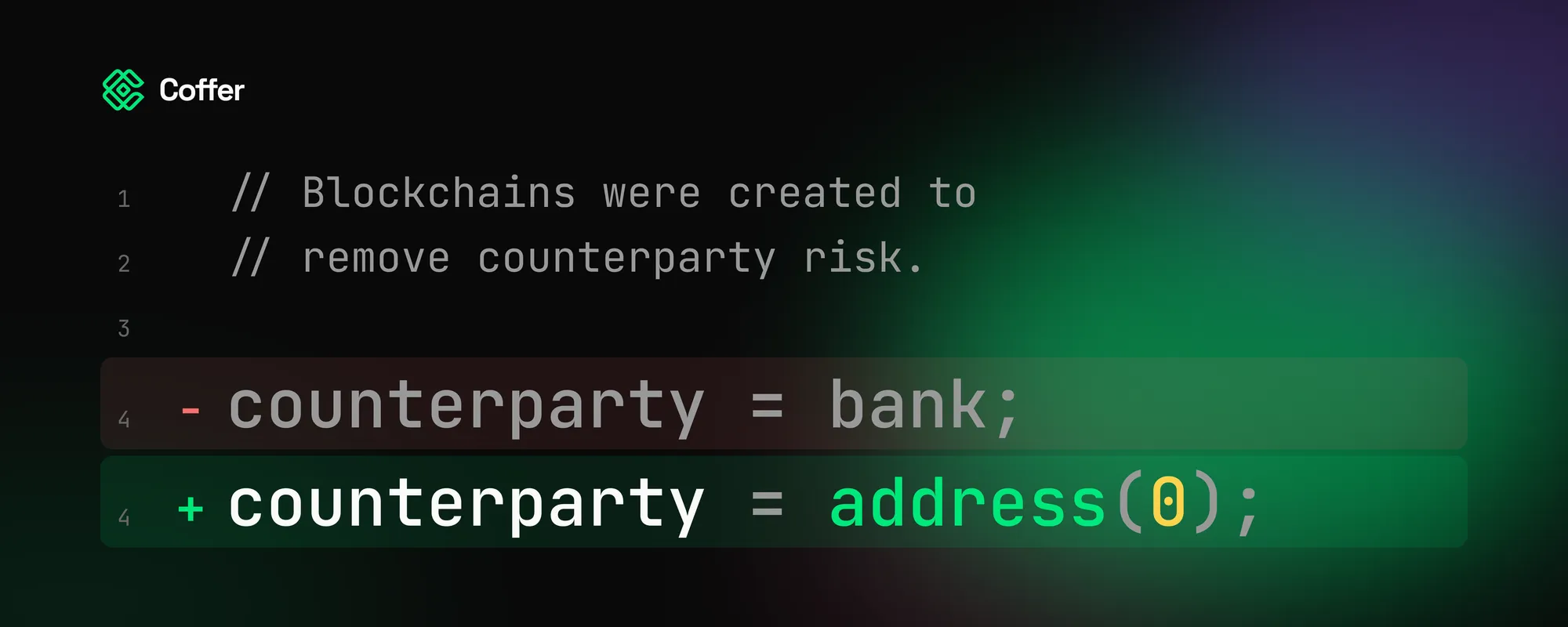
Some time ago I heard Ethereum researcher Danny Ryan talk about how important counterparty risk is, and a Reddit post I stumbled upon recently reminded me of it. The post asked where Web3 can create real value beyond crypto and speculation. It raised the questions that come up in almost every discussion about blockchain.
- Which industry stands to gain the most from Web3 in the coming years?
- When is a blockchain the right tool, and when is a plain database better?
- Which Web3 use case has real staying power?
While writing my reply, I realised how well his point answers questions like these. Once you understand counterparty risk, it becomes much easier to tell a database problem from a blockchain problem. A blockchain makes sense only when there is a counterparty to remove. If you trust the operator anyway, a database is faster and cheaper. If the operator is the risk, a blockchain gives you something no traditional setup can match.
In a traditional system you always have to trust whoever sits in the middle, whether that’s a bank, an exchange, a company or a government. Decentralisation takes that party out. Wherever a counterparty can be removed, real value is created. That is where Web3 products will prosper, and it is the idea Coffer is built on.
The best proof is Uniswap. It holds nearly $4B in total value locked and handles about $2B in volume daily. That’s not a coincidence but a measure of the product’s value. People trade there because nobody holds their funds or approves their trades. When FTX collapsed in 2022, its customers couldn’t withdraw their money and waited years to be repaid. The exchange was the counterparty. On Uniswap, that can’t happen. Its core contracts can’t be changed or paused, and it needs no oracle. Token holders can vote on how trading fees are split, but no vote can move or freeze the funds in the pools.
Uniswap works the way Ethereum first described smart contracts, as “applications that run exactly as programmed without any possibility of downtime, censorship, fraud or third-party interference.” Over time, oracles and governance became standard in decentralised applications. Oracles report prices and other facts from outside the chain, which makes lending and many other features possible. Governance lets token holders fix and improve a decentralised application. Both are useful, but both bring counterparty risk back in. You have to trust the oracle to report the truth, and you have to trust the voters not to change the rules after you have committed your money. That is why some might see blockchains as just another database.
Lending platforms and stablecoins carry some of this risk. Most lending platforms value collateral with price oracles, so a wrong price can liquidate borrowers. Many also let token holders change the rules or even upgrade the contracts. Stablecoins have grown to about $300B, but the companies behind the biggest ones hold the reserves and can freeze any address.
Even so, blockchain features like transparency still give both of them an edge over the traditional system. For stablecoins the edge is smaller. You still trust a company to hold the reserves, but anyone can send a dollar without a bank in the middle and follow every transfer. For lending the edge is much bigger. The biggest lending platform alone has about $12B out on loan, and nobody needed a bank’s approval for any of it. Every loan and its collateral is public in real time, while a bank never shows its loans one by one, only summaries in its quarterly reports.
Removing oracles and governance from a decentralised application is not enough if the chain underneath can be captured. A blockchain is only as neutral as the validators who secure it, and if a handful of them can collude, they become the new middleman. That is why a chain should care about its validators as much as it cares about the people who hold its coin. Validators are users too, just of a different kind. Running a validator should be open to anyone, with the lowest barrier to entry the network can allow. A chain whose incentives keep inviting new validators makes it very hard for any small group to take control.
Ethereum treats removing counterparty risk as a priority in its core design, and it has the most battle-tested smart contract platform to build on. About 44 million ETH is staked across more than 800,000 validators, and anyone with 32 ETH can run one on consumer hardware.
Ethereum has even changed its own protocol to take a counterparty out of how staking exits work. Before EIP-7002, only a validator’s signing key could start an exit, so whoever ran the node could hold the stake hostage. EIP-7002, co-authored by Danny Ryan, lets the owner of the stake trigger the exit from the execution layer, where smart contracts live. That means a smart contract can now control a validator’s stake on behalf of several parties. Each of them can claim their share under the contract’s rules, without trusting whoever runs the node. That change is what makes Coffer possible, and since we believe Ethereum is the chain that works hardest to keep counterparty risk out, it was the obvious choice for us.
So back to the questions from that post. The industries with the most to gain are the ones built on trusting a middleman, and finance is first in line. A blockchain is the right tool whenever there is a counterparty to remove. The use cases with real staying power remove that counterparty completely, the way Uniswap does.
Any product whose main advantage is removing counterparty risk can only be built on a blockchain. Uniswap took years to reach its full potential, and many products like it haven’t been built yet. Some may be in development right now without the market noticing. We believe Coffer is one of them.